
Ideation Meaning and Process

Ideation is the creative process from which ideas are generated, developed and communicated, all the way to being implemented. Through techniques like brainstorming, mind mapping, and SCAMPER, participants explore various possibilities and connections to solve challenges and gain new insights.

Creative Thinking
Collaboration
Innovation
Implementation

What is Ideation?

Ideation is a space where creativity and innovation meet. It's a collaborative environment where open innovation and co-creation are encouraged. By working together as a team, participants can build on each other's ideas, combining different knowledge to create unique solutions. Prototyping and testing ensure that the most promising ideas are refined and implemented. Innovation management platforms contribute to efficiency and organization in executing the process.

Throughout the journey, perseverance and growth are encouraged. Successes are celebrated, and any setbacks are seen as opportunities for learning and improvement in future ideation sessions.

In this stimulating world of ideation, the seeds of progress are sown, propelling individuals and organizations towards brighter and more impactful futures. It's a process that promotes continuous improvement, drives innovation and positive change across various fields.
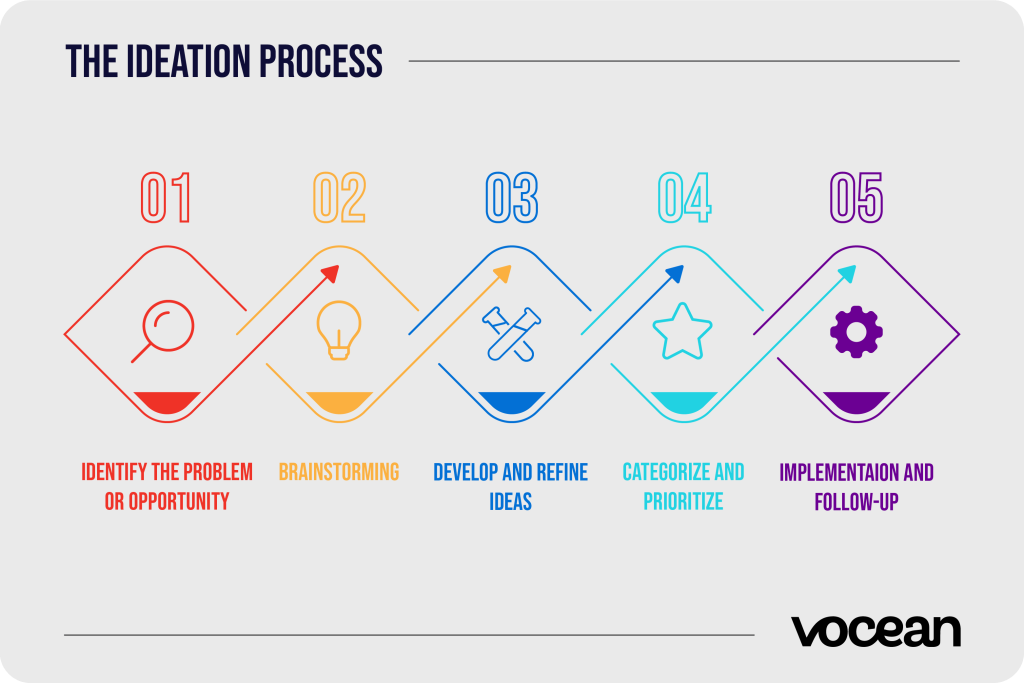
Ideation process illustration

The Ideation Process

Ideation is not a single action but a whole process from generation to implementation. For successful ideation, each step is important and they will be explained here:

1

Identify the Problem or Opportunity

Clearly define the challenge you want to tackle or the opportunity you want to explore.

2

Brainstorming

Generate as many ideas as possible. Encouraging completely judgment-free creativity allows participants to dare share their wildest ideas, which is often where the most genius innovations arise. Albert Einstein's quote on innovation supports this view: 'If an idea doesn't seem absurd at first, there's no hope for it.'

3

Develop and Refine Ideas

Work on the selected ideas, develop them and refine them together to make them more feasible and effective.

4

Categorize and Prioritize

Organize and categorize the ideas, then prioritize the most promising ones based on relevance and potential impact.

5

Implementation and Follow-up

Implement the chosen ideas and regularly evaluate the results.

Why is Ideation Important?

Ideation is a powerful process with many benefits. It enables multiple perspectives and encourages innovation. It also promotes creativity, which can lead to unusual ideas that wouldn't have been thought of otherwise. By generating and evaluating multiple solutions, the organization's problem-solving ability improves. Ideation enables continuous improvement and empowers employees, promoting a positive work culture. In summary, it drives positive change and growth within organizations. Here are 5 key benefits of ideation explained in more detail:

Diverse Perspectives

Ideation encourages participation from diverse individuals with different backgrounds, experiences, and expertise. This diversity creates a broader set of perspectives, leading to more comprehensive solutions. When people with different viewpoints collaborate, they can challenge each other's assumptions and generate ideas that might not have been possible in a homogeneous group.

Creativity and Innovation

The ideation process brings together creativity and innovation. It allows people to think outside the box, explore unusual ideas, and break free from traditional thought patterns. The process encourages brainstorming and wild ideas without judgment, which can lead to breakthrough concepts and solutions.

Effective Problem-solving

Effective ideation helps identify and define problems more accurately. By generating multiple ideas and potential solutions, it becomes easier to analyze and evaluate different options. This improves the overall problem-solving process and increases the likelihood of finding the most suitable and effective solution.

Continuous Improvement

Ideation is not limited to one-time events. It can be an ongoing process that enables continuous improvement and adaptation to changing circumstances. By regularly generating new ideas and revisiting existing ones, organizations can stay competitive and effectively handle new challenges.

Employee Engagement

In a collaborative ideation environment, employees feel engaged and valued. Their voices are heard, and they can contribute to the organization's growth and development. This sense of ownership promotes a positive work culture and can lead to increased satisfaction, motivation, and employee retention.

How to Succeed with Ideation

We know there are many benefits to conducting ideation processes, but the results don't come by themselves. Here are some tips on how to succeed with ideation:

Create a Non-judgmental and Diverse Environment

Create an inclusive atmosphere where all participants feel comfortable sharing their ideas without fear of criticism. Encourage participation from people with different backgrounds, experiences, and perspectives. Embracing differences enhances the diversity of ideas and solutions, leading to more innovative outcomes.

Set Clear Goals and Constraints

Clearly define the problem you want to tackle or the opportunity you want to seize. Setting specific goals and constraints can guide creativity toward practical and relevant solutions. Innovation KPIs can be used to quantify progress toward goals and ensure they are measured.

Use Creative Ideation Techniques

Use various ideation techniques such as mind mapping, reverse thinking, brainwriting, or forced relationship. These techniques can help stimulate creative thinking and make it easier to generate new ideas.

Encourage Collaboration and Teamwork

Create an environment that promotes collaboration and teamwork. Encourage participants to build on each other's ideas and work together to develop and improve solutions.

Combine Ideas

Look for ways to combine different ideas to create new and innovative solutions. Sometimes merging seemingly unrelated concepts can lead to breakthroughs.

Test the Ideas

For practical ideas, consider creating prototypes or mock-ups to test feasibility and gather feedback. Iterative testing can help refine concepts.

Document and Organize Ideas

Keep track of all generated ideas, even those not immediately taken forward. Documenting ideas allows them to be revisited later or used as inspiration for future projects.

Iterate, Celebrate Success, and Learn from Failures

Understand that ideation is an iterative process and may require multiple sessions to refine and develop ideas further. Celebrate successful ideas and implementations and acknowledge and honor the team's achievements. At the same time, view failures as valuable learning opportunities to understand what didn't work and why. Use insights from both successes and failures to improve future ideation processes and enhance the quality of generated ideas.

Use an Ideation Tool

Consider using specialized software or tools to streamline and enhance the ideation process. In today's world of mass information, traditional ways of conducting ideation are not enough. To be structured and manage the process when handling large amounts of data, an ideation platform is crucial. Vocean is a platform created for this purpose. It has been developed to create innovative processes and involve many people.

Challenges of Ideation

It's clear that ideation brings many benefits, but there are some challenges to be aware of. We've compiled a list of 5 key challenges and some tips on how to overcome them:

Evaluation and Selection of Ideas

Being able to evaluate and select the most promising ideas from a large number of options is crucial but challenging. It requires careful analysis and consideration of factors such as feasibility, impact, and relevance. Using collective intelligence is very useful here. By using an open innovation platform like Vocean, ideas can be rated on scales, for example, how much impact the idea can have. These ratings can be set together by the team, and individuals can also vote for their favorite ideas, making it easy to see which proposals are most popular according to the group.

Overcoming the Fear of Being Judged

Participants may be influenced by a fear of being judged, making them reluctant to share unusual ideas. Overcoming this and creating a safe, non-judgmental environment is crucial for effective ideation. An ideation technique like brainwriting can also be used to let people share their ideas anonymously, putting focus on the idea rather than the idea bearer.

Generating Valuable Ideas

Finding original and groundbreaking ideas can be difficult, especially when dealing with complex problems. By coming up with large quantities of ideas, the chance of achieving a breakthrough increases. A prerequisite for this is that the organization has the capacity to handle large amounts of ideas, which can be done with an innovation platform.

Implementation and Alignment with Organizational Goals

Putting ideas into action can be a complex process. Using resources efficiently, identifying and managing constraints, and ensuring alignment with organizational goals are crucial for successful implementation. It's important to always keep the organization's goals in mind when creating ideation processes. Creating reports based on the results of the processes is also a way to make it easy for decision-makers to act on the ideas.

Managing the Process

Collecting, storing, and organizing the large amount of ideas that come in during ideation processes can also be challenging. Here, an ideation platform is a must if the process contains a large amount of data. To handle all these challenges, effective facilitation, open communication, and an initiative to promote a creative and supportive environment are required. By overcoming these obstacles, you can arrive at innovative and valuable solutions that drive positive change and growth within organizations and projects.

Ideation Tools and Techniques

There are several proven techniques that can be used to stimulate creative thinking and generate new ideas.

Brainstorming

This is perhaps the most well-known technique when it comes to ideation. Brainstorming is about coming up with as many ideas as possible. Encouraging a free flow of creativity without judgment allows participants to dare share all their thoughts. Every idea is accepted, encouraging everyone to submit their most radical and unusual ideas. Brainstorming is usually done in groups where everyone chips in and participates. After each idea is submitted, they are categorized and voted on. Since a group of people have different ideas, many suggestions will be submitted. It's therefore usually considered quite resource-intensive to handle them all. Another common disadvantage of brainstorming is the imbalance in who comes up with the ideas. Some people are naturally more forward and others more shy. Status can also play a role. It's therefore important to have a system in place where many people can submit their ideas without being judged.

Reverse Thinking

Reverse thinking, also known as reverse brainstorming, is a way to look at a problem from a different perspective. Instead of just thinking about solutions, it takes a more problem-oriented approach. For example, if you're trying to build a following on social media, instead of thinking about how to get followers, think about what would make someone NOT follow you. Not posting regularly, too many sponsored collaborations, low-quality content, etc. People often find it more fun to find opposite solutions. You can thus create more engagement by thinking about how NOT to solve the problem! Companies also tend to get stuck in their old thoughts and ideas, making them blind to things that are otherwise very obvious. Reverse thinking can make those ideas that should be obvious, obvious. After the negative solutions are found, they are reversed again... Back to our earlier example about how you lose all your followers. The solution now becomes to post regularly, fewer sponsored collaborations, and to post good and valuable content.

SCAMPER

SCAMPER is a technique used to generate ideas by building on existing products or services through questions. It's an acronym that stands for: S – Substitute C – Combine A – Adapt M – Modify P – Put another use case E – Eliminate R – Reverse. These verbs are used to formulate discussion topics, usually in the form of asking questions. For example, 'substitute' can be transformed into the questions: 'Can this product be used as a replacement for something?' Or 'What resources can be substituted to improve this product?' And the same can be done with each of these verbs. One thing missing from this model is the cost aspect. However, this is something always kept in mind, so it can be seen as the invisible extra C.

Forced Relationship

Forced relationship is used by combining two different ideas that are not usually combined. Forcing these things together requires thinking outside the box and can give innovators a new perspective. Combining unrelated ideas doesn't always create a meaningful solution directly, but if the attempt provides a useful insight, it can be classified as a success. An example of when a relationship used to seem strange is the mobile camera. A few years ago, it was unthinkable to use the phone for anything other than calling. Today, most people don't even own a camera but take pictures every day on their phones.

The 5 W's

The 5 W's stands for a set of questions to ask. By asking these questions, you get a better picture of the problem at hand. The five different types of questions can be used in different ways depending on what you want to achieve. For example, the questions can be used both to understand a problem or to improve an already existing potential solution. The 5 W's are: What, Why, Who, When, Where. Another variant is 5 'whys'. This method is used to get a deeper understanding of a problem. By continuing to ask 'why?' you go from a thorough understanding down to the roots of the problem.


Tip: If you want a more constructive and solution-oriented approach instead of just trying to find answers to the question 'Why?', try instead asking 'How?'.

Mind Mapping

Mind mapping is a creative technique that makes it easy to visualize thoughts and ideas. It's used to organize information in a way that makes it easier to understand and explore possible connections and solutions. In a mind map, you place the main idea in the center and then use branches to connect it with different thoughts, ideas, and subcategories related to the main idea. This creates a network of connections and possible solutions. Mind mapping not only promotes creative thinking but also helps improve memory and information processing. It's an effective technique for brainstorming, organizing thoughts, and finding patterns or relationships between different ideas.

Brainwriting

Brainwriting is a method that builds on the principles of brainstorming, but with a written approach. Instead of verbalizing ideas, participants write down their thoughts on a given topic or problem on paper or using a digital platform. These written ideas are then passed on to other team members who build on them. This process encourages co-creation and idea generation from multiple team members simultaneously and also reduces the influence of dominant personalities. This creates a more inclusive process.

Storyboarding

Storyboarding is a technique commonly used in visual storytelling, such as film production, advertising, and UX design. In storyboarding, a sequence of visual sketches or illustrations is created and sorted in chronological order to show the development of an idea. Storyboarding provides the opportunity to visualize concepts, identify potential gaps or inconsistencies, and refine ideas before the final product.

Six Thinking Hats

Six Thinking Hats is a structured method for decision-making and idea generation. It involves using six metaphorical 'thinking hats', each representing different perspectives or ways of thinking, to approach a problem or explore a topic. The hats are assigned colors, and participants metaphorically 'wear' each hat to adopt the corresponding thinking mode. These modes are: White hat (Neutral and Objective): Focuses on facts, data, and available information. Red hat (Emotional and Intuitive): Takes feelings into account. Black hat (Critical and Cautious): Identifies potential problems and risks. Yellow hat (Positive and Optimistic): Explores benefits and values. Green hat (Creative and Innovative): Encourages creative thinking and new ideas. Blue hat (Metacognitive and Control): Manages the thought process and sets the agenda. By wearing these 'hats' in sequence or selectively, individuals or teams can thoroughly explore a problem or idea from different perspectives, leading to more comprehensive solutions.

Conclusion

Ideation is a powerful process that promotes creativity, problem-solving, and innovation, and is an important part of growth within organizations. By using different techniques and tools, participants can explore a wealth of opportunities to overcome challenges and innovate. The open and supportive environment where diversity and collaboration are embraced helps open up new perspectives and possibilities. With the right techniques, tools, and mindset, organizations can harness the power of ideation to drive innovation and positive change.

It's clear how important a platform for ideation is to successfully come up with new ideas and overcome challenges. Vocean enables effective inclusion of people in ideation processes and makes it easy to handle large amounts of data, thus helping to find breakthrough solutions.

Ready to Start Your Ideation?

Discover how Vocean can help you effectively involve people in your processes and find breakthrough innovations.

No setup required
You own your data
Expert support included
GDPR Compatible
Global Scale
Personal Advisor